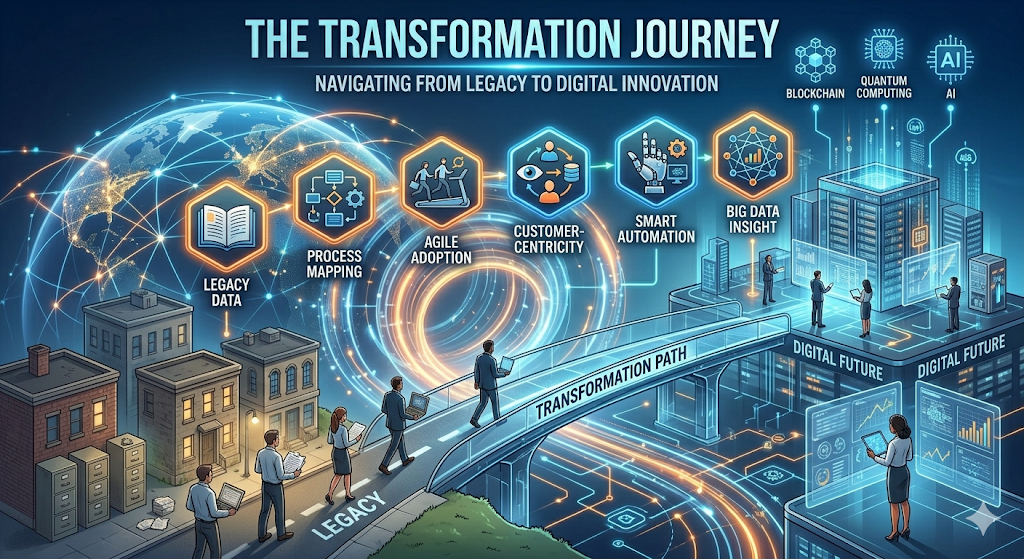
Digital transformation has evolved from a technology modernization effort into a full-scale business transformation imperative. Today, enterprise leaders are not simply responding to technological change. They are responding to structural shifts in competition, cost dynamics, customer expectations, workforce models, and value creation.
Volatile markets, sustained cost pressure, compressed innovation cycles, and rising stakeholder expectations require organizations to rethink how they operate at every level. In this environment, incremental improvement is no longer sufficient. Enterprise digital transformation demands a reimagination of operating models, decision frameworks, customer engagement, and performance management, powered by advanced technologies, AI implementation, and generative AI consulting.
At its foundation, digital transformation is about embedding digital capabilities, advanced analytics, automation, artificial intelligence, and generative AI into the enterprise core. It integrates strategy, technology, operating models, governance, and talent to create measurable performance improvement. Sustainable digital transformation occurs when digital investments align directly with business priorities and are executed with discipline through structured digital transformation roadmaps.
Increasingly, organizations are partnering with AI consultants and digital transformation strategy consulting firms to ensure that technology adoption translates into measurable business outcomes rather than isolated system deployments.
What Is Digital Transformation and Why It Is Essential for Enterprises
In practical terms, digital transformation is the deliberate, enterprise-wide redesign of how an organization creates value, delivers services, operates processes, and competes in a digital economy. It is not a one-time IT upgrade or a standalone cloud migration project. It is an ongoing business transformation enabled by digital technologies, AI implementation services, generative AI consulting, data modernization, and new ways of working.
Executives who succeed in digital transformation treat it as a strategic business initiative rather than an IT-led program. Technology plays a critical role, but the objective is performance improvement across cost efficiency, agility, resilience, customer experience, and revenue growth.
Enterprise digital transformation typically involves redesigning five interconnected dimensions:
- How value is created through digital products, services, and intelligent platforms
- How end-to-end processes are streamlined using automation and AI implementation
- How decisions are made using advanced analytics, predictive intelligence, and generative AI
- How governance and operating models enable accountability and speed
- How talent is reskilled and supported through digital tools and AI augmentation
Organizations that approach digital transformation strategically achieve stronger outcomes because they connect technology deployment to measurable business impact. Those that focus only on system upgrades often struggle to generate sustainable value.
Digital transformation is essential because it enables enterprises to simplify operations, reduce friction, automate repetitive tasks, and scale efficiently. It strengthens resilience by creating adaptive operating models. It enhances customer and employee experiences by delivering digital-first engagement. Most importantly, it positions organizations to compete effectively in an AI-driven economy.
Key Drivers of Digital Transformation
Digital transformation is shaped by multiple reinforcing pressures. Understanding these drivers allows leaders to define more effective digital transformation strategies and prioritize AI implementation initiatives that deliver measurable value.
Market and Competitive Pressure
Digital-native organizations operate with agile, data-centric business models and AI-enabled decision systems. They scale faster and innovate continuously. Established enterprises must modernize through digital transformation solutions, generative AI consulting, and AI-driven automation to remain competitive and defend market share.
Cost and Productivity Demands
Traditional cost-reduction programs often deliver diminishing returns. At the same time, enterprises face rising labor and operational costs. AI implementation services, workflow automation, intelligent process orchestration, and generative AI tools reduce manual effort, improve productivity, and allow growth without proportional headcount increases.
Demand for Data-Driven Decision Making
Legacy systems and fragmented data environments limit visibility and slow decision cycles. Enterprise digital transformation modernizes data architecture, integrates platforms, and enables advanced analytics and AI-powered insights. Generative AI further enhances reporting, summarization, forecasting, and scenario modeling to support faster, more informed decisions.
Evolving Customer and Employee Expectations
Customers expect seamless, digital-first experiences with personalization and transparency. Employees expect modern digital tools, simplified workflows, and intelligent assistants. AI consultants and generative AI consulting services help organizations redesign customer journeys and internal workflows at scale.
Advances in AI and Generative AI
The rapid advancement of artificial intelligence, machine learning, and generative AI has expanded what is possible across business functions. AI implementation now supports predictive maintenance, demand forecasting, dynamic pricing, fraud detection, customer support automation, document intelligence, and autonomous workflow management.
Generative AI consulting enables enterprises to deploy AI copilots, automated knowledge assistants, intelligent content generation, and decision-support systems that augment human capabilities and improve speed and accuracy.
Operating Model Complexity
Siloed organizational structures and unclear governance slow execution. Enterprise digital transformation simplifies operating models, clarifies accountability, and aligns technology investments with measurable outcomes. AI consultants often play a critical role in defining governance frameworks and adoption strategies to ensure transformation success.
Benefits of Digital Transformation and AI Implementation
When executed with discipline and strategic alignment, digital transformation delivers measurable enterprise performance improvement.
Improved Operational Efficiency
Digital transformation solutions streamline end-to-end workflows through automation, intelligent orchestration, and AI implementation. Organizations reduce manual work, eliminate redundancy, and standardize processes. This lowers operating costs while improving service levels and scalability.
Enhanced Decision Quality
Modern data platforms combined with AI implementation services provide real-time insights and predictive analytics. Generative AI enhances reporting, summarization, and modeling, enabling leaders to forecast more accurately and respond proactively to emerging risks and opportunities.
Greater Agility and Responsiveness
Digitally enabled enterprises adapt more quickly to supply disruptions, regulatory changes, demand volatility, and competitive shifts. Integrated systems, automation, and AI-powered analytics reduce response time and improve cross-functional coordination.
Elevated Customer and Employee Experience
Digital transformation improves omnichannel customer engagement, reduces service friction, and enables personalization through AI-driven recommendations. Employees benefit from intelligent tools, digital assistants, and generative AI copilots that reduce administrative burden and increase analytical capacity.
Accelerated Innovation and Growth
By modernizing infrastructure and simplifying operations, organizations free resources to focus on innovation. Generative AI consulting supports rapid prototyping, knowledge discovery, and new business model development. AI implementation enables experimentation at scale while maintaining governance and control.
Stronger Enterprise Resilience
Integrated digital ecosystems enhance visibility, standardization, and control. AI-powered monitoring and predictive analytics allow organizations to identify disruptions early and respond effectively. Digitally mature enterprises sustain performance more consistently during economic or operational shocks.
Building a Digital Transformation Roadmap
A successful digital transformation process requires more than ambition. It requires structured execution guided by a clear digital transformation roadmap.
An effective roadmap includes:
- Clear articulation of strategic business objectives
- Baseline benchmarking of current performance
- Prioritization of high-impact digital transformation solutions
- Defined AI implementation strategy aligned with governance
- Phased deployment of cloud, automation, analytics, and generative AI
- Workforce enablement and change management
- Continuous measurement of adoption and value realization
Digital transformation strategy consulting and AI consultants help enterprises reduce execution risk by providing structured diagnostics, best practices, and measurable performance frameworks.
How The Hackett Group® Accelerates Enterprise Digital Transformation
The Hackett Group® supports enterprise digital transformation by anchoring initiatives in measurable business outcomes. Through benchmarking, structured diagnostics, and Digital World Class® performance standards, organizations identify performance gaps and prioritize high-impact transformation initiatives.
The Hackett Group® integrates digital transformation strategy consulting with practical execution support, helping organizations design realistic digital transformation roadmaps. Its approach incorporates:
- End-to-end process transformation
- AI implementation and automation enablement
- Data modernization and analytics integration
- Operating model redesign
- Governance and performance management
- Talent enablement and workforce transformation
By combining benchmarking insight, generative AI consulting perspectives, structured diagnostics, and disciplined execution frameworks, The Hackett Group® helps enterprises sustain value realization throughout their digital transformation journey.
Endnote
Digital transformation is no longer optional. It is a foundational enterprise strategy for performance improvement, resilience, and long-term competitiveness. Organizations that rely on isolated technology deployments or incremental improvements risk falling behind in an increasingly AI-driven economy.
Sustainable digital transformation requires clear business alignment, disciplined AI implementation, strong governance, and consistent adoption. Generative AI consulting and AI consultants now play an increasingly central role in accelerating business transformation and unlocking scalable value.
Ultimately, digital transformation is about building an enterprise that can adapt continuously, decide intelligently, and compete confidently in an environment of constant disruption. Organizations that approach enterprise digital transformation with strategic clarity, structured roadmaps, and measurable performance focus will be best positioned to lead in the digital economy.
 The Hackett Group®
Leave a comment